

Why Choose Us
Rich Experience
We are committed to the mechanical parts processing market and provide well-known CNC equipment manufacturers and automation companies in South Korea, China and other countries.
Customized Service
Conduct product accuracy analysis based on the drawings provided by the customer, and communicate with the customer about the drawing requirements and product process.
Advanced Equipment
The existing factory building is 5,400 square meters and has more than 30 sets of equipment from well-known manufacturers in South Korea, Taiwan, and China.
After-Sale Service
Professional and thoughtful after -sales team, let you worry about us after -sales Intimate service, strong after -sales team support.
What is Axis Core
Axis core is one of the elements of mechanical transmission and movement, usually also called shaft center. It is a load-bearing element that connects the upper and lower parts of the transmission device, and its role is to transmit torque and support part of the weight of the machine, while also ensuring transmission accuracy and stability.
Related Product

Confidentiality system (taking confidentiality and security measures for your drawings and personal information)
Measurement equipment (complete mechanical processing equipment)
Price advantage (more affordable compared to accessories of the same level)

This product is mainly formed in one go by a car milling composite machine or completed by a lathe and vertical machining,
The main process route is material - turning and milling center or material - lathe - vertical machining
This product is mainly used for automotive transmissions.

This product is mainly a CNC vertical machining center bearing seat, made of 45 steel. The main process route is material - heat treatment - lathe - vertical machining.
This product injects lubricating oil into the bearing holes through internal penetration to ensure the lubrication effect of the bearings.
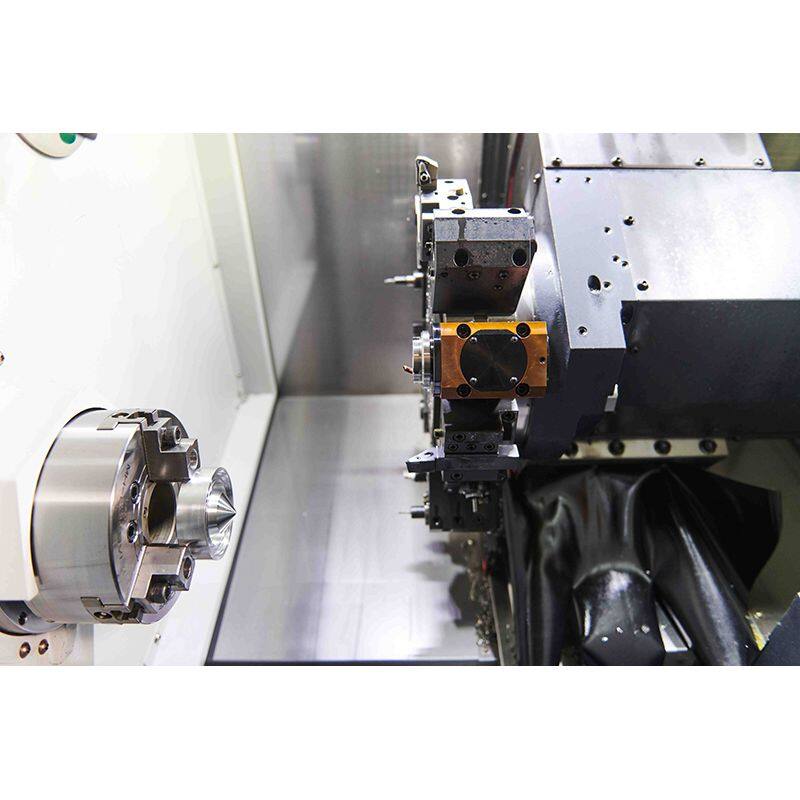
Turning and Milling Composite Products
This internal equipment mainly processes some complex components, such as turning and milling integrated machines, to avoid product instability caused by secondary clamping
I can make commonly used materials such as aluminum, 45 steel, stainless steel, etc.

This product is mainly a CNC horizontal CNC lathe turret accessory and an integrated (HT300) casting. The main process route is casting vertical machining surface treatment
The main function of this product is to clamp the turning tool and play a turning role.

The internal equipment is mainly used for final rough machining and precision machining of machined parts
Mainly processing structural components, castings, and large plate interiors
Applicable materials: 45 steel, HT300 castings.

This product is mainly used to fix equipment pipelines such as cooling pipes, hydraulic pipes, etc. The material is nylon 66, and the main process route is material - vertical reinforcement.

This product is mainly used for cooling workpieces at the spindle end of vertical machining. The material is 45 steel, and the main process route is material vertical machining surface treatment.

This product is mainly an automation part, made of aluminum 6061. The main process route is material - vertical machining - surface spraying (aluminum oxidation)
Control the accuracy within 0.01mm.
What Are the Advantages of Axis Core
High precision and high hardness
Axis core has very high precision, the minimum size of up to 0.1mm, tolerance of 0.001mm, and usually the hardness of HRC58-60, both toughness and Hardness, can meet the high precision and high hardness requirements of the application scenario.
Customized solutions
The axis core can be customized according to the special requirements of customers, providing customized solutions, which helps to better adapt to the needs of the production line and reduce the fixture replacement and adjustment time due to the differences in the size and shape of the workpiece. fixture replacement and adjustment time due to differences in workpiece size and shape, thus improving production efficiency.
Improve productivity and ensure product quality
By accurately matching workpiece dimensions and machining requirements, customized high-precision arbors ensure workpiece machining accuracy and consistency, improve product quality, and reduce scrap and rework rates due to machining errors, significantly reducing long-term productivity. and rework rates due to machining errors, significantly reducing long-term production costs.
Reduced production costs
Although the initial investment in customized high-precision arbors may be high, the increased productivity and product quality assurance they bring can significantly reduce long-term production costs.
Role of the Axis Core
The primary role of the arbor is to support the rotating part and to transmit only bending moments and not torque.
Cores play an important role in mechanical structures, and they are categorized into several types, including mandrels, drive shafts, and rotor shafts. Mandrels are mainly subject to transverse loads, produce bending deformation and play a supporting role without transmitting power; drive shafts are used to transmit power, bear torque and produce torsional deformation; and rotary shafts are used to support rotating parts. produce torsional deformation; the rotating shaft is to support the transmission and transfer power at the same time, and at the same time by the transverse load and torque, produce a combination of bending and torsion deformation.
In more specific applications, the design and selection of the axis core is critical to the performance of the mechanical system. For example, in automotive manufacturing, the use of a mandrel can effectively ensure the cross-sectional shape of the bend, without destroying the cross-sectional shape of the bend, an appropriate increase in the amount of mandrel reach can be somewhat mitigated Springback and tube wrinkling phenomenon. This shows that the correct selection and use of the core for improving mechanical efficiency and product quality has a decisive impact.
The application of arbor is not only limited to the industrial field, they are also widely used in daily life, such as the shaft of the railroad vehicle is an example of arbor, these shafts rotate but do not transmit power. And in computer keyboards, the shafts underneath the keys are also a form of arbor, they are responsible for the process of physical and electrical triggering, so that the computer can recognize the specific key pressed by the user, thus ensuring the normal use of the keyboard and the accurate input of computer commands.
Types of Axis Core
A shaft that bears both bending and turning moments in operation, mainly used in applications that require both rotating and bending loads.
Mainly used for fixing workpiece, according to its different structure form, the mandrel can be divided into small taper mandrel, nut compression step mandrel and rising force mandrel. Small taper mandrel positioning accuracy is higher, but loading and unloading of the workpiece is not very convenient, suitable for smaller batches, higher precision, axial positioning requirements of the workpiece; nut compression step mandrel is suitable for loading and unloading of the workpiece. Step mandrels are suitable for clamping multiple workpieces and workpieces with not too high precision requirements; upward force mandrels are convenient for loading and unloading workpieces with high precision, and they are suitable for sets of parts with large aperture tolerances.
Mainly used to support transmission parts, transmission torque and load, according to the different structural forms, drive shafts can be divided into light shafts, stepped shafts and shaped shafts, or solid shafts, hollow shafts and hollow shafts, or solid shafts, hollow shafts and hollow shafts. Or it can be divided into solid shafts, hollow shafts, etc. These types are mainly based on the specific application scenarios. These types are mainly selected according to specific application scenarios and design requirements to meet different mechanical properties and structural requirements.
Difference Between Shaft Center and Axis Core


Definition of axis and core
Axis is the axis along which an object rotates when it is rotated along a certain axis, and is the fundamental centerline that defines rotational symmetry. The axis is usually the axis of symmetry of a solid object, such as the center axis of a ring.
A core, on the other hand, is the axis of a mechanical device that transmits forces and carries loads, and is usually the axis of a hollow object. In practice, the core is usually the central axis used to transmit power or torque effects, such as the crankaxis core of an engine.
Difference between shaft center and axis core
Although shaft center and axis core are both concepts of axis, they have different meanings in definition and application.
First of all, in definition, axis core emphasizes the concept of symmetry and fundamental centerline, which is usually the axis of a solid object. The core, on the other hand, emphasizes the transmission of force and load bearing, and it is usually the axis of a hollow object.
Secondly, the use of shaft centers and cores differs in practical applications. Cores are usually used to describe the rotational symmetry of an object, such as the center axis of a ring. A axis core, on the other hand, is usually used to transmit the central axis of a power or torque action, such as the crankaxis core of an engine.
Applications of shaft centers and cores
Shaft centers and cores are very important concepts in machine building and engineering design. Shaft centers are usually used in design to determine the symmetry of an object, and then design according to the symmetry. Axle cores, on the other hand, are often used to determine the power transmission path in various mechanical transmissions.
For example, in automobile manufacturing, the crankaxis core of the engine is the central axis of the entire engine power transmission, and its position and accuracy determine the reliability and output power of the engine. And in the design and manufacture of bearings, the core is the key to determining the accuracy and load capacity of the bearing.
The main function of the axis core is to realize the connection between components so that the equipment can work normally.
As a mechanical part, the design of the structure and function of the axis core is crucial to the operation of the equipment. The axis core usually includes a connecting section, a rotating section and a fixing section. This structure enables the axis core to support and fix other parts when rotating, and at the same time, through the design of springs and clamping blocks, it is easy to clamp and stabilize other parts to prevent parts from falling off when rotating. At the same time, through the design of spring and clamping block, it is easy to clamp and stabilize other parts to prevent the parts from falling off during rotation. This design of the axis core not only improves the efficiency of installation and maintenance of parts, but also makes the axis core more convenient to install, use and replace.
Spools are used in a wide range of applications including, but not limited to, automotive parts, office automation parts, appliance parts, and power tool parts. These applications have high requirements for the accuracy and hardness of the axis core, for example, the minimum size of the axis core can be up to 0.1mm with a tolerance of 0.001mm, and the hardness is usually HRC58-60,... to ensure its performance and durability in various working environments.
Arbors can be categorized as rotating or fixed arbors depending on whether they rotate during operation. Rotating mandrels are subjected to bending moments during operation while the shaft rotates, while fixed mandrels are subjected to bending moments during operation but the shaft is fixed. In addition, depending on the role of the shaft and the load it is subjected to, the mandrels can be further subdivided into center shafts, rotary shafts and transmission shafts. These classifications help to better understand and apply the role of axis cores in different equipment and systems.
What Are the Commonly Used Materials for Axis Cores?
Steel: Steel is one of the most commonly used materials in the manufacture of axis cores, usually characterized by high strength, high abrasion resistance and plasticity, which is suitable for high-speed rotating parts. Common steel materials include 45# steel, 40Cr steel, 65Mn steel and so on.
Aluminum: Aluminum has a light weight, good thermal conductivity and other characteristics, suitable for low load, low-speed movement of the core components. Aluminum commonly used materials include 2024 aluminum alloy, 6061 aluminum alloy and so on.
Copper: Copper has good electrical conductivity, wear resistance, corrosion resistance, etc., in the transmission of electric current or manufacture of motor rotors and other fields are widely used. Commonly used copper materials are C11000 copper, C14500 copper-nickel alloy.
Titanium: Titanium material has both high strength, light weight and other advantages, so it is used in high-speed rotation, high strength load and other occasions. Common titanium materials are TA1, TA2, TA3 and so on.
Carbon fiber: Carbon fiber has light weight, high strength characteristics, in high-speed rotation, high temperature operation and other requirements of special mechanical components are widely used. The advantage of carbon fiber core is that it is not easy to produce thermal expansion in high-speed rotation, so it has the stability of high-speed rotation. At the same time, carbon fiber has a very high specific strength and can withstand high loads. Commonly used carbon fiber materials are T700, T800, T1000 and so on.

The core material can be made of a variety of materials, including POM, POK, and special nylon.
In some shaft designs, the core is made of POM, which has ultra-low coefficient of friction, high wear resistance, etc., and can bring a smoother and more stable pressing experience, and the more you use it, the smoother it becomes. POM material is characterized by ultra-low friction coefficient and high wear-resistant loss. The self-lubricating property of POM material makes this smoothness last longer.
In addition, some shaft designs use POK material for the axis core, which also provides a smooth pressing experience and has good wear resistance.
Special nylon material is also used for the axis core, which has good abrasion resistance and mechanical strength to meet the requirements of long-time use.
Application Areas of Axis Core
Motors, printers, copiers, scanners: Miniature shafts are widely used as rotary shafts in various motors, printers, Copy machines, scanners, etc. These components require high precision and small size design.
Utomotive parts: Axis core is also used in automotive parts, including one of the key components in automotive engines, which can withstand high temperature, high pressure and high speed working environment, and is connected with the piston and crankshaft of the automotive engine to transform the rotary motion of the engine. It is connected to the piston and crankshaft of the automobile engine, and converts the rotary motion of the engine into the forward power of the automobile.
Office automation parts: These include parts in office automation equipment that require high precision and small size to ensure the performance and reliability of the equipment.
Household appliance parts: Small rotating parts in household appliances, such as fans, stirrers, etc., which require high precision and small size design.
Power tool parts: Rotating parts in power tools, such as drills, sanders, etc. These parts require high-precision and small-size designs to ensure the performance and safety of the tools.
Standard mandrels in the field of metrology: Used to measure straightness, roundness, runout, perpendicularity and parallelism and other dimensional and form tolerance parameters detection, to improve the efficiency and accuracy of detection. They are used in leveling zero checking, use of profilometer fixtures and calibration balls, coaxiality testing, and insulating tape abrasion test devices.
Application of fluxing mandrel in machine tool industry: As one of the key components of the machine tool, it is used to support and transmit power to ensure the accuracy and stability of the machine tool. Through the transmission of the rising mandrel, the rotational speed and torque of the machine tool spindle can be accurately controlled to ensure the machining quality and efficiency of mechanical parts.
Our Factory
Zhangjiagang Xinshuo Machinery Co., Ltd. was established in December 2012. The company is located in Zhangjiagang, Suzhou, a national health city. It is a CNC enterprise integrating R&D, production, sales and service. After years of development, we have an experienced team Our high-level professional technical team owns many high-end brand products from Europe, America, Japan, Korea and Taiwan, and is able to provide our customers with high-quality CNC processing solutions. We are committed to the mechanical parts processing market and provide well-known CNC equipment manufacturers and automation companies in South Korea, China and other countries. Provide precision parts processing and manufacturing.
Xinshuo Machinery is committed to creating maximum value for customers and continuing to innovate. It adheres to the business principle of centering on the core needs of customers and the business philosophy of professionalism, innovation, co-creation and sharing, uses numbers to quantify value, and builds a benchmark in the CNC industry.

FAQ


