

As a supplier of CNC machine bases, ensuring the high - performance of our products is not only a commitment to quality but also a key factor in meeting our customers' diverse needs. Testing the performance of a CNC machine base is a comprehensive process that involves multiple aspects and techniques.
1. Structural Strength and Rigidity Testing
One of the fundamental performance indicators of a CNC machine base is its structural strength and rigidity. A weak base can lead to vibrations during machining operations, which in turn affect the accuracy and surface finish of the workpiece.
To test the structural strength, we often use finite element analysis (FEA). This software - based technique divides the CNC machine base structure into small elements and analyzes the stress, strain, and deformation under different loads. By simulating various machining scenarios, we can identify potential weak points in the base design. For example, during heavy - duty cutting, the tool exerts a significant force on the workpiece, which is transferred to the machine base. FEA can predict whether the base can withstand this force without excessive deformation.
In addition to numerical simulations, physical testing is also essential. We can apply static loads to the CNC machine base using hydraulic jacks or other loading devices. The deformation of the base is then measured using precision displacement sensors. If the deformation exceeds the specified tolerance, it indicates that the structural rigidity of the base is insufficient, and further improvements are needed, such as adding reinforcement ribs.
2. Damping Performance Testing
Damping is another crucial performance parameter of a CNC machine base. Good damping performance can reduce vibrations and improve the stability of the machining process.
One common method to test damping is the impulse response test. A small impact is applied to the CNC machine base using an impact hammer, and the resulting vibrations are measured using accelerometers. The decay rate of the vibrations can be analyzed to calculate the damping ratio. A higher damping ratio indicates better damping performance.
We can also use the modal analysis technique to study the dynamic characteristics of the CNC machine base. Modal analysis can identify the natural frequencies and mode shapes of the base. By avoiding the coincidence of the natural frequencies of the base with the excitation frequencies during machining, we can prevent resonance, which can cause severe vibrations and damage to the machine.

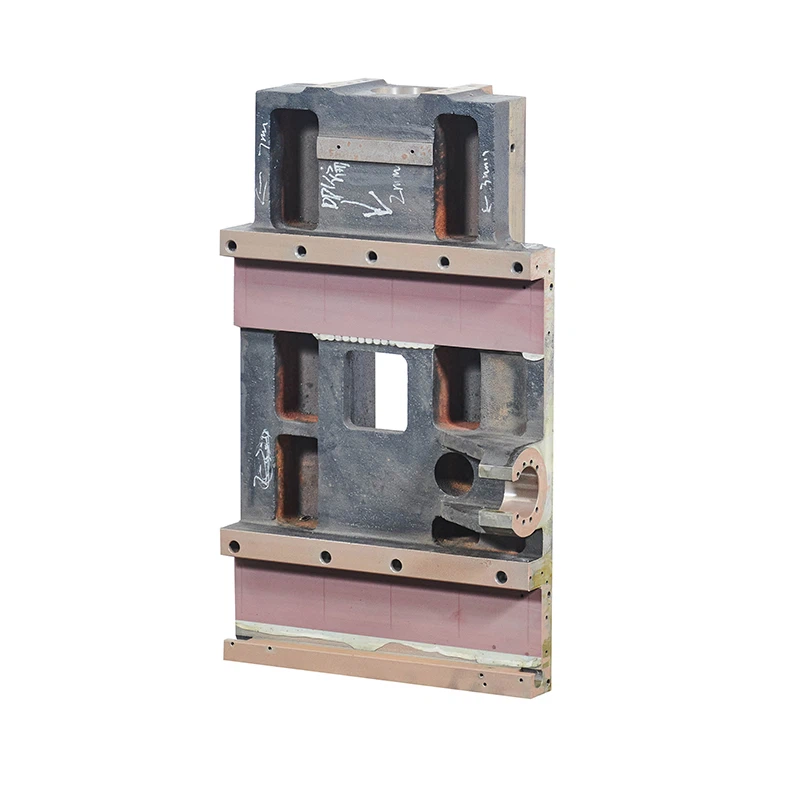
3. Geometric Accuracy Testing
The geometric accuracy of a CNC machine base directly affects the positioning accuracy and repeatability of the machine. Several geometric parameters need to be tested, including flatness, straightness, perpendicularity, and parallelism.
For flatness testing, we can use a precision level or a laser interferometer. The level can measure the inclination of the base surface at different points, and the laser interferometer can provide highly accurate measurements of the surface profile. If the flatness error is too large, it can cause the machine components to be installed unevenly, leading to inaccurate machining.
Straightness testing is usually carried out using a straightedge or a laser alignment system. These tools can detect any deviations from a straight line in the guideways or other linear components of the machine base. Perpendicularity and parallelism testing can be performed using angle - measuring instruments and dial indicators. Ensuring the correct geometric relationships between different parts of the base is essential for the proper functioning of the CNC machine.
4. Thermal Stability Testing
During long - term machining operations, the CNC machine base will be affected by heat generated from the spindle, motors, and cutting process. Thermal expansion and contraction can cause changes in the geometric accuracy of the base, which in turn affects the machining accuracy.
To test the thermal stability of the CNC machine base, we can use temperature sensors to monitor the temperature distribution across the base during operation. At the same time, we use precision displacement sensors to measure the dimensional changes of the base due to temperature variations. By analyzing the relationship between temperature and dimensional changes, we can evaluate the thermal stability of the base.
To improve thermal stability, we can use materials with low thermal expansion coefficients for the base construction. Additionally, we can design cooling channels in the base to dissipate heat effectively.
Applications of High - Performance CNC Machine Bases
Our high - performance CNC machine bases have a wide range of applications in different industries. For example, the Precision Pipe Cutting Machine Base requires a stable and accurate base to ensure the precision of pipe cutting. With our high - quality bases, the cutting process can be carried out with high accuracy and repeatability.
The Bending Machine also benefits from our CNC machine bases. The strong and rigid base can withstand the large forces generated during the bending process, ensuring the stability and accuracy of the bending operation.
In the field of turning, the CNC Lathe Saddle needs a well - designed base to support the saddle's movement and the cutting forces. Our bases can provide the necessary support and precision for high - quality turning operations.
Why Choose Our CNC Machine Bases
We take pride in our commitment to providing high - performance CNC machine bases. Through strict performance testing, we ensure that each base meets the highest quality standards. Our experienced R & D team is constantly working on improving the design and manufacturing process of the bases to adapt to the ever - changing market demands.
If you are in need of high - quality CNC machine bases, we invite you to contact us for procurement negotiations. We are confident that our products can meet your specific requirements and provide you with excellent service. Let's work together to achieve more in the field of CNC machining.
References
- Smith, J. (2018). Handbook of CNC Machine Tool Design. Cambridge University Press.
- Jones, A. (2019). Fundamentals of Machine Tool Dynamics. Oxford University Press.
- Brown, W. (2020). Precision Engineering and Manufacturing. Taylor & Francis.